Tag: technology

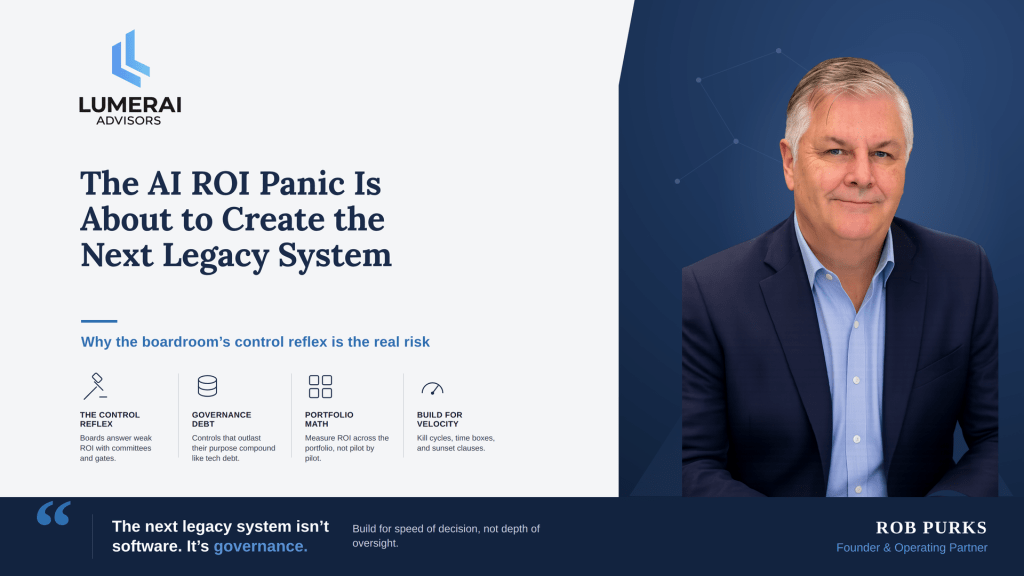
  • The AI Panic Is About to Create the Next Legacy System

    The AI Panic Is About to Create the Next Legacy System

    There is a quiet panic spreading through boardrooms right now, and it has nothing to do with whether AI works. It has to do with whether anyone can prove it.

    The numbers behind that panic are real. Hyperscalers are on track to spend roughly $675 billion on AI infrastructure this year alone. Meanwhile, MIT’s Project NANDA found that 95% of enterprise AI pilots deliver no measurable P&L impact. S&P Global reported that 42% of companies abandoned most of their AI initiatives last year which is more than double the rate of the year before. Forrester is now predicting a market correction with enterprises deferring a quarter of their planned 2026 AI spend into 2027. Even the debt markets have weighed in: Citi identified a measurable credit spread penalty for companies classified as AI adopters without evidence of return. Spending without proof is now literally priced into the cost of capital.

    I am not here to argue with the data. The data is right.

    I am here to argue with the response.

    Key Takeaways

    • The disappointing AI ROI is real, but the boardroom response is the danger. The reflex to add steering committees, business cases, and approval gates rebuilds the rigid structures that already neutralized cloud and agile.
    • This creates Governance Debt. Controls that outlast the uncertainty they were built to manage compound quietly, like technical debt – except a legacy operating structure has no migration project.
    • Build for velocity instead. Replace approval gates with kill cycles, measure ROI at the portfolio level rather than per use case and put a sunset clause on every control. The winners out-decide their peers; they don’t out-govern them.

    The Control Reflex: Why AI Governance Backfires

    When boards see numbers like these, they react the way boards have always reacted: with control. AI steering committees and per-use-case business cases. ROI attestation before funding. Approval gates between pilot and production. Governance councils that meet monthly to review initiatives that move weekly.

    Every one of these mechanisms is individually defensible. That is exactly what makes them dangerous.

    I have spent my career on both sides of this dynamic, as a CIO running technology for telecom operators in Latin America, and later advising enterprises on transformation at Accenture, IBM, and Ericsson. And I can tell you what happens next, because I have watched it happen with every major technology wave: the control structure built to manage today’s uncertainty becomes tomorrow’s constraint. It outlives the problem it was created to solve. Nobody is ever promoted for dismantling a governance committee.

    I learned this the hard way by inheriting the aftermath of one. At a Latin American operator a major CRM transformation had been put in front of a review board and killed on grounds that were individually hard to argue with: the projected budget was steep, the internal skills weren’t fully in place, and the business wasn’t deemed ready. Every objection was reasonable. The board did exactly what it was designed to do. And while we sat on a defensible “not yet” a competitor moved, modernized its customer platform, and took ground we never fully recovered. The control worked perfectly. The company lost anyway. That is the trap: the most dangerous governance failures don’t look like failures at all, they look like prudence.

    We have seen this exact movie before. Cloud and agile both promised speed. In most enterprises they delivered something closer to “the same speed with more meetings.” The technology arrived, the operating model absorbed it, neutralized it, and carried on. The gains didn’t disappear, they were quietly strangled by slow decisions and diffused accountability.

    The ROI panic is now rebuilding that machinery, at speed, with the best of intentions. Except this time there is a difference that should worry every executive: when the constraint is a legacy system you can eventually migrate off it. When the constraint is a legacy operating structure there is no migration project. It just becomes how the company works. I call this Governance Debt: the accumulated drag of controls that outlast the uncertainty they were built to manage. Like technical debt it compounds quietly and like technical debt the interest is paid in speed.

    The Wrong Diagnosis: It’s Not an AI Adoption Problem

    Here is the tell that we are solving the wrong problem. In one of the most striking findings of this cycle 97% of executives report personally benefiting from AI yet only 29% see significant organizational ROI.

    Read that gap carefully. It is not an adoption problem. It is not a model-quality problem. And it is emphatically not a control problem. It is a compounding problem. Value is being created at the level of individuals and teams and the organization has no mechanism to aggregate it, redirect it, or build on it. Adding oversight to that situation does not create compounding. It adds friction to the one place value actually exists.

    Look at what the successful 29% actually have in common: AI tied to revenue outcomes, business teams owning the workflows, and the whole effort treated as organizational redesign rather than technology deployment.[1] Notice what is not on that list: more approval gates.

    The organizations seeing returns did not out-govern their peers. They out decided them.

    What to Build Instead: A Velocity-First AI Operating Model

    If the answer isn’t heavier oversight, what is it? Three structural moves none of which require a committee:

    Replace approval gates with kill cycles. Don’t make initiatives prove their worth before they start, make them prove it on a clock. Every AI initiative launches with pre-agreed kill criteria and a fixed time box. The discipline shifts from “may we begin?” to “did we learn enough to continue?” That is governance measured in velocity, not meetings.

    Measure ROI at the portfolio level, not the use case. Demanding a business case from every individual experiment guarantees you will only fund the safe, incremental, and ultimately unimportant. Venture and private equity investors figured this out decades ago: the portfolio carries the math so the individual bets can take real risk. It is the same logic that drives value creation across a portfolio of companies, you manage the aggregate, not the average. Boards should hold leadership accountable for portfolio-level return and learning rate, not for the survival of any single pilot.

    Put a sunset clause on every control. Any governance mechanism created to manage AI uncertainty should carry an expiration date and a renewal test: what decision did this body accelerate this quarter? If the honest answer is none, it isn’t governing, it’s accumulating. This is how you keep Governance Debt off the balance sheet. Controls that can’t justify their existence in terms of speed are the new technical debt written in org charts instead of code.

    The Real Risk: Rigidity, Not AI

    I wrote recently about the hidden risk of AI transformation – The Hidden Risk of AI: Building Transformation Programs for a Future That May Not Exist: building rigid multi-year programs for a future that may not exist. The ROI panic is that same risk wearing a more respectable suit. Rigidity in the name of innovation and rigidity in the name of fiscal discipline produce the identical outcome – an enterprise that cannot move when the landscape shifts. And the landscape is shifting quarterly.

    The correction Forrester predicts will happen. Budgets will tighten and they should. But the companies that emerge ahead will not be the ones that built the most rigorous AI oversight. They will be the ones that built the fastest honest decisions about what to fund, what to scale, and above all, what to kill.

    The last generation of legacy systems was written in COBOL. The next one is being written in committee charters. Choose carefully which one you build.

    Frequently Asked Questions

    Why are 95% of enterprise AI pilots failing to show ROI?

    According to MIT’s Project NANDA, 95% of enterprise AI pilots deliver no measurable P&L impact. The cause is rarely the technology or the model. Value is created at the level of individuals and teams but most organizations have no mechanism to aggregate that value, redirect it, or build on it which is a compounding problem, not an adoption or model-quality problem.

    Does adding more AI governance improve AI ROI?

    Usually not. Steering committees, per-use-case business cases, and approval gates add friction to the place where AI value actually exists. Organizations reporting significant ROI did not out govern their peers they out decided them by tying AI to revenue outcomes, giving business teams ownership of workflows, and treating the effort as organizational redesign rather than technology deployment.

    What is Governance Debt?

    Governance Debt is the accumulated drag of controls that outlast the uncertainty they were created to manage. Like technical debt it compounds quietly and its interest is paid in speed. Unlike a legacy software system, a legacy operating structure has no migration project, it simply becomes how the company works.

    How should boards measure AI ROI by use case or by portfolio?

    At the portfolio level. Demanding a business case from every individual experiment funds only the safe and incremental. As venture and private equity investors learned long ago, the portfolio carries the math so individual bets can take real risk. Boards should hold leadership accountable for portfolio-level return and learning rate, paired with pre-agreed kill criteria and time boxes for each initiative, not for the survival of any single pilot.


  • Strategies for Technology Execs – Navigating the Opex Conundrum

    May 31, 2026

    Strategies for Telecom Executives—Navigating the OPEX Conundrum

    As the market becomes increasingly competitive and technology evolves rapidly, telecommunications industry (telecom) leaders must find ways to achieve more with less — managing operating expenses (OPEX) without sacrificing critical capabilities. This balancing act is especially difficult in a capital-intensive industry like telecom, where infrastructure investments and IT systems are crucial for ongoing operations. In this post, we’ll examine the key drivers behind OPEX pressures in telecoms and how to navigate them with greater confidence.

    The OPEX Dilemma: Managing Costs Without Sacrificing Capabilities

    A key challenge for telecom executives is managing the ratio between revenue and IT/technology OPEX. While OPEX can be controlled in areas like marketing with reductions in planned spending, lowering IT and technology costs is more complicated. These expenditures are tied to core business systems and services that power the business, such as network management, billing, data storage, customer relationship management and security systems. Success in this area has always required structured review, negotiations and tough decisions to manage resources, systems and vendors.

    System roadmapping is a critical component of gaining OPEX efficiency. Determining what systems to retire, maintain or invest in lays the foundation for cost reductions and more effective investments. An effective roadmap involves not only evaluating current system architecture, skills availability and cost of ownership, but also considering future business needs. By assessing the total cost of ownership (TCO) and the return on investment (ROI) for each system, organizations can make informed decisions about where to allocate resources. This process also highlights areas where automation or integration can improve operational efficiency, reducing manual effort and enhancing agility.

    To create a successful system roadmap, involve key stakeholders from IT, operations, finance and leadership to ensure all needs are considered. Driving consensus requires aligning the roadmap with the company’s broader business objectives, prioritizing systems for efficiency, and using data-driven decision-making. Regular reviews and feedback loops will help adjust the plan as business needs evolve.

    Balancing Innovation and OPEX Efficiency

    Whether it’s new product offerings, expanded 5G networks or building out new infrastructure, telecoms are competing heavily to differentiate themselves against established and emerging players in the market. Telecoms must find ways to fund innovation without letting OPEX spiral out of control.

    Technologies like automation, AI and cloud-based services require significant upfront CAPEX investment but can drive long-term OPEX efficiency. For example, AI-driven network optimization tools may have high initial costs but improve network management, leading to long-term savings. Most will require additional funding in areas of talent management as well as infrastructure to leverage these technologies effectively — a hit against the OPEX numbers.

    This is where a long-term strategy that prioritizes sustainable value over short-term savings come in handy, but only if you can help sell the vision to the board, show a clear path to achieving the goals agreed upon with IT and finance executives, and get support from across the business to take part in the successful execution of the plans.

    OPEX efficiency and innovation do not happen in a vacuum, so the closer IT leaders work with their finance counterparts, the stronger the outcome.

    Are Software Vendors Crunching Your OPEX?

    Telecoms often rely on software vendors for systems like ERP, network management and CRM for operations. These are not strategic tools, but rather, mission-critical, taking up a significant portion of the IT budget. Adding to the cost are continuous upgrades and push to the cloud, all of which can show little to no ROI for the business, but come with the threat of losing support or being locked out of new innovations.

    To take greater ownership of one’s IT roadmap, reduce unnecessary spending and maximize the value of existing systems, telecom leaders should explore third-party support options that can better align with their objectives and provide better, more expert support and services. Third-party support can extend the useful life of your system while avoiding the CAPEX costs and risks of upgrades.

    When your existing enterprise system is stable, robust and tailored to your needs, replacing it with new technology can introduce unnecessary risk. Instead, leverage your proven system as a foundation for business innovation through third-party support, while significantly reducing support costs and saving OPEX.

    More importantly, shifting funds from the treadmill of upgrades to real innovation helps to close the gap between tomorrow’s possibility and today’s capability, driving meaningful change for the business.

    Building a Sustainable Approach to OPEX Management

    In a competitive industry where technological evolution is constant, staying ahead requires not just cutting costs but investing wisely for the future. In part two, we’ll explore strategies for managing these OPEX challenges effectively and examine what it means to embrace a flexible, composable IT strategy.

    ____________________________________________________________________________

    Rob Purks is a Founding Partner at Lumerai Advisors , a technology strategy advisory firm. Lumerai Advisors provides an unbiased perspective which is not influenced by vendor relationships.  With over 150 years of CIO and technology experience, the founding partners bring an honest and complete perspective on technology strategies and challenges.

  • Strategies for Technology Execs – Balancing Innovation and Opex

    Overview

    In most telecom environments, OPEX pressure isn’t driven by a single decision — it’s the cumulative effect of years of architectural layering, vendor dependencies, and well-intentioned investments that no longer align to where the business is going.

    What’s interesting is that when organizations start moving toward more composable approaches, it often becomes less about technology and more about clarity — understanding what should actually change versus what can be optimized and extended.

    Interested to hear how others are approaching this right now — are you seeing a shift toward more targeted, incremental modernization, or are full transformation programs still the default path?

    Balancing Innovation and OPEX in Telecom: Why Composable ERP Is Emerging as a Strategic Imperative

    Telecom leaders are being asked to do something that is fundamentally at odds — accelerate innovation while simultaneously reducing operating expenses. As networks expand, regulatory demands increase, and technology cycles compress, this tension is becoming more acute across the industry.

    In my previous article, Strategies for Telecom Executives—Navigating the OPEX Conundrum, I explored the structural pressures driving this challenge. The reality is clear: traditional cost-reduction approaches are no longer sufficient when technology spend is deeply embedded in the core of the business.

    The question now is not whether to invest, but how to do so with greater precision, flexibility, and long-term impact.

    One of the most practical approaches emerging in the market is composable ERP.

    Composable ERP is not about replacing entire systems. It is about rethinking how enterprise platforms evolve. By breaking systems into modular components, telecom organizations can retain stable, proven core capabilities while selectively modernizing areas that drive the most value.

    Rather than committing to large-scale, high-risk transformation programs, leaders can align investment decisions more closely to business outcomes—introducing new capabilities where they are needed, without triggering unnecessary cost escalation or operational disruption.

    This approach enables telecom operators to scale infrastructure without overprovisioning, accelerate time-to-market for new services, and improve cost efficiency by maximizing existing resources. It also supports incremental modernization by integrating new technologies alongside legacy systems, allowing organizations to innovate without overhauling their entire environment.

    At the same time, composable architectures create a foundation for automation. AI-driven capabilities can reduce operational overhead, improve service delivery, and shift resources away from manual processes toward more strategic initiatives.

    What emerges is not just a technical architecture, but a different operating model—one that prioritizes continuous evolution over episodic transformation, business-driven decision-making over vendor-led roadmaps, and targeted investment over broad, capital-intensive change.

    For telecom executives, the implication is clear. The path forward is not about choosing between innovation and cost discipline. It is about building the structural flexibility to achieve both.

    Composable ERP represents one of the most effective ways to begin that shift.

    ____________________________________________________________________________

    Rob Purks is a Founding Partner at Lumerai Advisors , a technology strategy advisory firm. Lumerai Advisors provides an unbiased perspective which is not influenced by vendor relationships.  With over 150 years of CIO and technology experience, the founding partners bring an honest and complete perspective on technology strategies and challenges.

    #Telecom #DigitalTransformation #ITStrategy #CIO #EnterpriseArchitecture #OPEX #AI #Cloud #LumeraiAdvisors

  • Act now or Fall Behind

    Act Now or Fall Behind: Telecom’s Response to Economic Pressure

    The telecom industry is entering one of the most turbulent periods in recent memory. This moment is defined not by competition or consumer demand, but by economic policy and geopolitical complexity. With new tariff policies in flux, combined with an expected increase in inflation, telecom providers are facing a perfect storm of rising costs, squeezed margins and market uncertainty. While some may wait for clarity, telcos that move boldly now by embracing innovation, breaking free from rigid technology dependencies and rethinking their cost structures will be best positioned for success. 

    Telecom’s new economic reality

    Current U.S. trade policy includes significant tariff increases, expected to stabilize at 10% on all imports from many countries. This is a sharp jump from the 2024 average U.S. rate of 2.5%, and represents a 300% increase, signaling a policy shift that will certainly reshape how the telecom industry builds, funds and scales its infrastructure. 

    For telecom carriers and equipment vendors, the impact is direct and substantial. Equipment costs – already elevated from earlier tariff rounds – are expected to rise again. Those costs include critical infrastructure that can’t be compromised like routers, switches, antennas and fiber-optic components. And with a 10% tariff already proposed, companies must take immediate steps to prepare for operational and financial impacts.   

    Rising capital costs add pressure

    Tariffs are just one part of the financial pressure. If inflation increases, the risk-free rate of capital will rise, reflected in the form of higher interest rates. That means:  

    • Higher cost for building and maintaining infrastructure 
    • Slower rollout of new technologies like 5G and edge computing 
    • Delays in capital investment stalling current and future transformation initiatives 
    • Tighter capital budgets and possible headcount reductions 
    • Lower earnings and declining share prices 

    And perhaps most importantly, a strong likelihood of higher prices for consumers, who are expected to bear the brunt. Lagging consumer demand due to high costs presents yet another risk to growth and profitably for telcos already running on thin margins.  

    Strategies in motion: Localization, diversification and risk

    Telecom leaders aren’t standing still. In fact, some have already begun reshaping their strategies in response to earlier waves of tariffs and supply chain stress.  

    Ericsson’s smart factory in Texas is a prime example. Built with anchor commitments from major U.S. carriers like AT&T and Verizon, it now produces a significant portion of equipment domestically to sidestep both tariffs and global shipping delays. Nokia has also partnered with U.S. contract manufacturers to support domestic production and maintain compliance with federal broadband funding rules.  

    Other carriers are employing a “China Plus One” supply chain strategy that promotes diversifying manufacturing and sourcing operations beyond China to reduce dependency and mitigate risk. Still, these moves introduce their own complexities: longer lead times, operational fragmentation and, in some cases, increased risk exposure. 

    Many providers are delaying major investments, including parts of 5G deployments, not because of lack of demand, but because of financial uncertainty. 

    The innovation bottleneck: Vendor lock-in

    Vendor lock-in represents one of the most dangerous, less-visible barriers to innovation. Many telcos are still tethered to rigid enterprise software support models that hinder agility and create innovation bottlenecks. 

    In a world that demands flexibility, some software vendor relationships are now “cement shoes,” slowing down innovation, complicating integration with emerging technologies and driving up costs just to maintain the vendor’s status quo. Upgrades are expensive. Customizations are restricted. And replatforming takes too long. 

    In this environment, every dollar saved on support costs is a dollar that can be reinvested into innovation. Reducing reliance on inflexible software vendors allows telcos to self-fund innovation by accelerating time-to-market, unlocking new revenue opportunities and regaining control of their IT roadmaps. 

    The path forward: Act now or fall behind

    The message is clear: waiting is not a successful strategy. Telecom providers must implement a proactive approach focused on:  

    • Rethinking sourcing and production strategies to minimize tariff exposure 
    • Prioritizing open, modular technology platforms that adapt to change 
    • Eliminating vendor lock-in to unlock agility and lower long-term costs 
    • Investing in innovation, even amid uncertainty, to stay ahead of customer and competitive demands 

    In an industry where timing is everything, hesitation can be costly. The telcos that emerge stronger will be those that take decisive action now—not only to weather volatility, but to also use it as a catalyst for long-overdue transformation.  

    ____________________________________________________________________________

    Rob Purks is a Founding Partner at Lumerai Advisors , a technology strategy advisory firm. Lumerai Advisors provides an unbiased perspective which is not influenced by vendor relationships.  With over 150 years of CIO and technology experience, the founding partners bring an honest and complete perspective on technology strategies and challenges.

  • The Hidden Risk of AI: Building Transformation Programs for a Future That May Not Exist

    The Hidden Risk of AI: Building Transformation Programs for a Future That May Not Exist

    For decades, enterprise transformation followed a familiar model: define a future state, build a multi-year roadmap, and execute with discipline. That model is now under pressure—not because transformation is no longer necessary, but because the assumptions behind it are rapidly breaking down.

    Large transformation programs rely on a core premise: that we can reasonably predict the future operating model. In an AI-driven environment, that premise is increasingly fragile. Capabilities are evolving faster than planning cycles, and organizations are designing multi-year programs against a moving target.

    McKinsey & Company has highlighted that while generative AI could create significant economic value, organizations are capturing impact fastest through incremental deployment embedded in existing workflows, not large, monolithic transformations. Value is emerging in shorter cycles, not long-duration bets.

    At the same time, execution risk was already high. Boston Consulting Group estimates that 70% of digital transformations fail to meet their objectives, even in more stable environments. AI does not reduce that risk—it amplifies it.

    But there is a more fundamental issue emerging—one that is still underappreciated.

    We are designing transformation programs without a clear understanding of what AI will actually be capable of in two to three years.

    This introduces a new form of exposure. Not just whether a program will be delivered successfully, but whether it is solving the right problem at all. Entire layers of functionality being built today—workflow orchestration, decision support, even elements of system integration—may be simplified, automated, or eliminated as AI capabilities mature.

    The risk is no longer just execution failure. It is design risk leading to solution irrelevance.

    Programs that are delivered on time, on budget, and exactly as designed—but no longer aligned with the business or technology landscape by the time they go live.

    This is why we are seeing leading organizations shift away from “big-bang” transformation toward more adaptive models. Composable architectures, incremental modernization, and shorter investment cycles are becoming the preferred approach—not as a compromise, but as a strategic response to uncertainty.

    The question is no longer, “What should our business look like in five years?”  It is, “How do we remain adaptable over the next five quarters?”

    For CEOs, CIOs, and private equity leaders, this has direct implications for capital allocation and risk management. Transformation programs must be structured with optionality—designed to evolve as capabilities evolve, rather than locking into a fixed future state.

    In many cases, the right answer is not to stop transformation—but to deconstruct it.

    ____________________________________________________________________________

    Rob Purks is a Founding Partner at Lumerai Advisors , a technology strategy advisory firm. Lumerai Advisors provides an unbiased perspective which is not influenced by vendor relationships.  With over 150 years of CIO and technology experience, the founding partners bring an honest and complete perspective on technology strategies and challenges.